
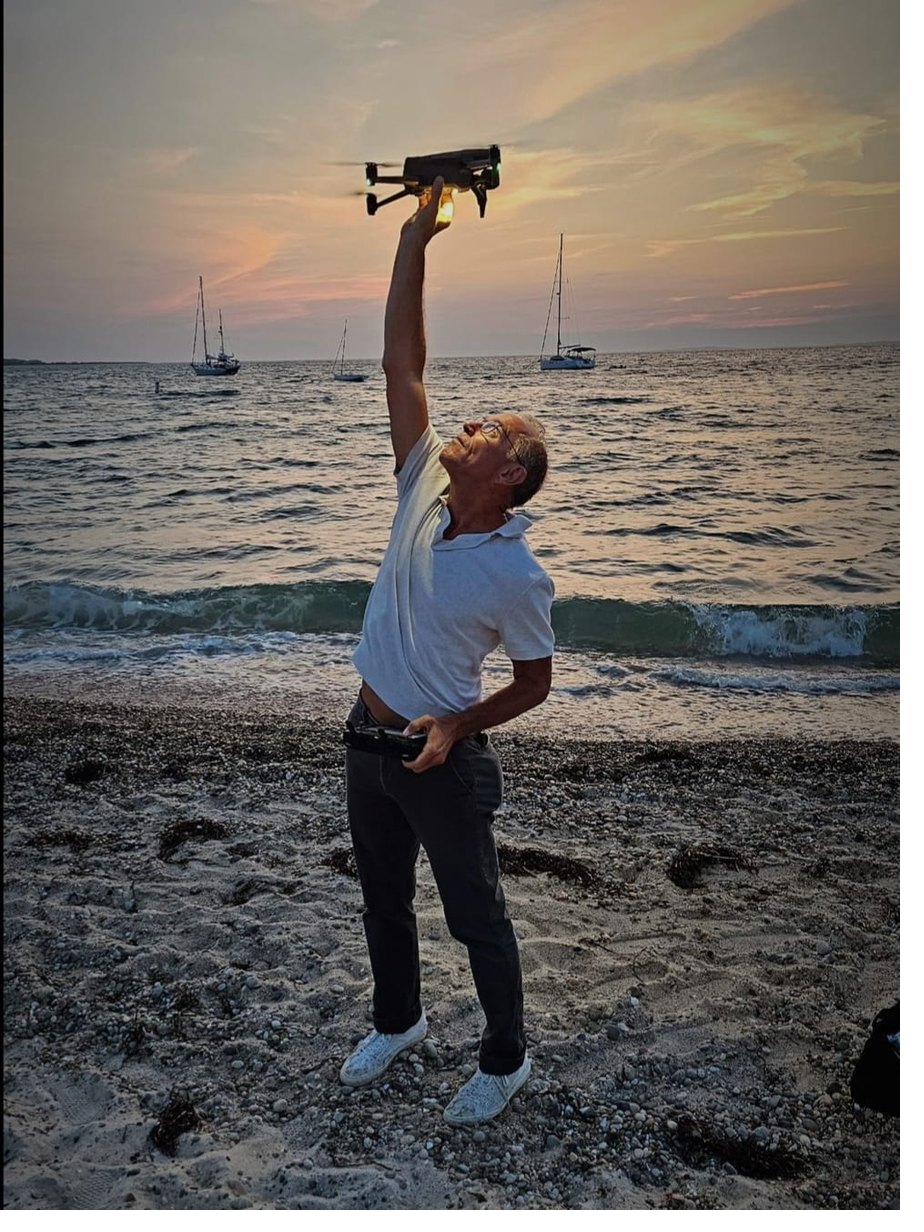
Joe Chancellor — founder, Rebel Video
A kid from a hilltown
I grew up in a hilltown. Not a place anybody markets. The nearest thing to a media industry was the transmitter on the ridge.
Everything I do now rests on a fact that would have sounded like science fiction there: a person with a laptop and twenty dollars can put a message in front of one specific human being, in one specific county anywhere in the country, who is at this moment researching the exact problem that person solves. Thirty years of television advertising couldn’t do that at any price.
It’s also why geography stopped mattering to the work. The campaign runs where your customers are, not where I am.
The badge, and what it teaches you about strangers
I enlisted in the Marine Corps at seventeen. Then I carried a badge as a police officer.
Police work isn’t what television says it is. Most of it is talking to people who don’t want to talk to you, in the worst ten minutes of their year, and getting them to decide — fast, on nothing but how you carry yourself — whether you’re someone they can tell the truth to. You’re reading a stranger and being read by one, simultaneously, dozens of times a week.
Nobody in advertising thinks of that as training. It’s the best training there is. An ad has five seconds to accomplish what a cop has to accomplish at a doorway, and the mechanism is identical: does this person seem like they already understand my situation, or are they reciting something at me?
Ten years in front of juries
I went to law school and spent ten years as a trial attorney.
Felony trials. The last one, a defendant charged with moving sixteen hundred pounds of drugs from Mexico to Boston. Civil cases that settled because the other side knew we would try them. Somewhere in there I interrogated a member of the Manson Family behind prison walls, which sounds like a flex until you’ve done it and understand that it was mostly listening.
A jury is twelve strangers who didn’t choose to be there, who can’t ask you a question, and who are deciding within the first minutes whether you’re worth believing. There’s no closer analogue to an ad audience anywhere in professional life. You don’t get to be interesting later. You’re judged on the opening.
You cannot argue someone into trusting you. You can only show that you already understand.
That’s what trial work beats into you and marketing never teaches. Everything after it is logistics. Every good ad I’ve written works on that principle, and every bad one I’ve seen violates it in the first sentence.
Afghanistan, and after
After the law, I spent a year in Afghanistan as an investigator for the Department of Defense. Then Raytheon and DynCorp, and an MBA from the Isenberg School of Management.
I’m not going to dress the Afghanistan year into a marketing lesson. It was a job, it was a long way from home, and it clarified what I wanted to spend the rest of my working life on. What I will say is that a year of establishing facts in a place where almost everyone had a reason to shade them permanently ruined my patience for marketing language — the confident vagueness, the numbers with no denominator, the case study with no client name attached. I don’t write that way and I won’t let a client run it.
The ad that changed the business
I built a YouTube ad designed to isolate a single profile: ultra-wealthy business professionals living on Martha’s Vineyard. Not a demographic. A person.
It found SQuire Rushnell — creator of the Hallmark Christmas movie franchise, the K-9 movie on Netflix, and the entire Godwinks book series. He was so struck that an ad had shown up calling out his exact profile that he booked a call immediately. Within the week he bought me lunch on the Vineyard, introduced me to his wife, and hired me to consult him on YouTube ads.
A man who spent his career commanding audiences at national scale got found by a guy with a laptop and a small daily budget. That isn’t a testimonial — it’s a proof of the mechanism. Everything Rebel Video sells is downstream of that afternoon.
Two principles I build on
The law of big numbers
The most valuable resource in business today is the ability to build your own highly detailed traffic. What large companies spend on television, billboards and radio — broad strokes at a shrinking audience that’s learned to put up blinders — is replaced by simple video ads at twenty dollars a day, shown to people already watching, already searching, already seeking the exact outcome you sell. The scale isn’t in the spend. It’s in the precision.
Hiding in plain sight
Half the “great content” people watch is an ad in disguise, especially on YouTube. The skill is producing the ad that arrives in front of the person seeking the outcome it offers and doesn’t announce itself as advertising on the way in. Most agencies don’t know how, because it’s a writing problem wearing a media-buying costume.
Why law firms, and what the big boxes can’t do
I work across verticals — roofing, solar, home services, coaches and course creators — but law is where I came from, and it’s where the difference between me and a large agency is easiest to see.
The firms you’re comparing me to run YouTube as one line on a menu of twelve services. Your campaign belongs to an account manager who has never tried a case, is carrying thirty other accounts, and will be replaced inside eighteen months. The script gets written by someone who learned what an arraignment is from a briefing document. It reads that way — and the viewer, who is in the worst week of their life deciding whether to trust a lawyer, can tell.
I practiced for ten years. I know what the client is actually afraid of, because I sat with a lot of them. I know what a bar rule requires before anyone has to send me the rule. And I know what most legal advertising gets exactly backwards: the credentials do not go at the open. A résumé in the first three seconds is a skip. What goes at the open is the one thing your right client already believes and has not said out loud.
The connection is the product.
The person who writes your script is the person who answers the phone, watches the numbers, and tells you when something isn’t working. That’s a real limit — I take a small number of clients, and when I’m full, I’m full. It’s also the entire reason the work compounds. A campaign doesn’t grow because a playbook got executed. It grows because one person’s judgment stays pointed at it, continuously, and notices things a dashboard won’t surface.
More on the specifics for firms: YouTube ads for law firms.
What I won’t do
- Run your campaign out of an account I own. It lives in your Google Ads account, the media runs on your card, and it never routes through me. If we stop working together you keep the account, the audience, the video and the data.
- Sell you leads or signed cases. The moment I own the audience and you rent access to it, I’ve put you in exactly the position I spend all day telling people to get out of.
- Build funnels, VSLs, webinars, or manufactured curiosity. Not on moral grounds — on effectiveness grounds. Those mechanics were built for a buyer who no longer exists.
- Tell you it’s a fit when it isn’t. I turn down work on the consult call regularly. Fifteen minutes of honesty costs me less than a client I can’t get results for.
Who I work with
Mike Gonet at Classic Metal Roofs has been a client for five years. Bob Ketric came in selling solar door to door, buying leads and showing up last; he’s running his own ads now. Ryan already worked full time as a marketing professional at another agency, joined the six-week program anyway, and within weeks was brought on by a law firm and a Las Vegas tour company to run their ads.
The common thread isn’t industry or geography. It’s that all of them sell something where the customer has to decide whether to trust a person, and none of them had a way to be that person before the phone rang. The full list is on who I’ve worked with.
No pitch deck, no pressure
I’ll look at your market before we talk and tell you straight whether YouTube ads are the right move — including when the answer is no. If you’d rather see the numbers first, they’re all on the pricing page.